XXII World Religions Conference - Proceedings Report


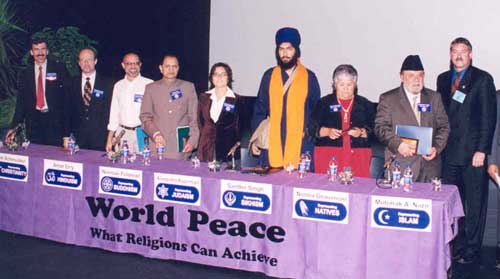
Speakers and Moderator of the XXII World Religions Conference

Theme: "World Peace - What Religions Can Achieve"

Edited by Nabeel A. Rana
Reporters: Dr. Ijaz Qamar, Ansar Raza

WATERLOO, October 5, 2002.

The World Religions Conference, has without doubt become one of the most inspiring gatherings held in the region of Waterloo and Brant.

Religion can be a realm of extraordinary power. It can offer solace in troubled times. It can make sense of the seemingly senseless because that's the world we live in. It can give us strength to meet the physical and spiritual challenges of life. Religion helps us find our place in the cosmos; it knits families and communities together; it endows individuals with compassion and morality.

The problems facing humanity now are so large and complex that no single people or nation can solve them in segregation; nor can the building of peace be the work of politicians or academia alone. It is a task to which all must contribute; and religious and spiritual leaders have an especially important character to play. Religions may not provide the technical solutions to all the world's problems, but they do offer a moral and spiritual wisdom that illuminates and teaches the transcendent truth of the human person.

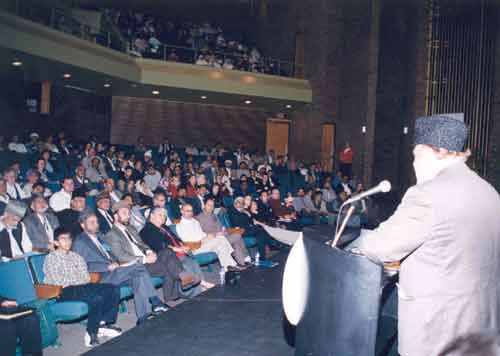
Religious and philosophical communities are the best organized and largest civil institutions in the world claiming allegiance to billions of followers, and bridging the divisions of race, class, and nationality. They are hence uniquely equipped to meet the challenge of our times - removing race-conflicts and wars, and making the world a peaceful society for all humans to co-exist. How religions can achieve this goal was the theme of discussion at the 22nd World Religions Conference, organized by the Ahmadiyya Movement in Islam Canada's Brantford Branch, held on Saturday, October 5, 2002 at the University of Waterloo Humanities Theatre. The 6 hour long conference was "a day of wisdom and insight, hope, singing and music, exotic food, and of love and brotherhood" as one guest so agreeably put it.

Cooperation to organize the event was received from the Ahmadiyya Muslim Students' Association, University of Waterloo and several other faith based groups from the University of Waterloo and the City of Waterloo, 2002 and was presided over and moderated by Mr. Dave Levac, MPP of Brant riding.

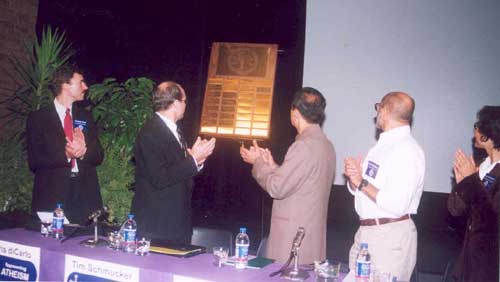
Like every year, representatives of all major religions were invited. For the first time a representative from the Atheist community was also invited to represent the Atheist Philosophy of life. The conference moderated and chaired by Mr. Dave Levac, MPP of the Brant riding, began with the recitation and reading of various Holy Scriptures of various faiths. The conference was formally opened by the unveiling of the "World Religions Conference Plaque". Several hundred delegates from diverse religious, cultural, social and academic backgrounds were in attendance.

Representatives of certain dignitaries read out their welcome messages to the delegates. This included a greeting from the Prime Minister of Canada, from the Premier of Ontario, Mayor of Waterloo and the President of the University of Waterloo. Present among the dignitaries were Ms. Karen Redman, MP (Kitchener Centre), Monte Kwinter - MPP (North York), Councilor Scott Jones - Councilor City of Waterloo (Representing Mayor Lynne Woolstencroft of Waterloo), Ms. Laura Talbot-Allan -Vice President University of Waterloo, Catharine Scott - Associative Provost Human Resources and Student Services University of Waterloo, Ms. Gurpreet Kaur Sodhi, NDP Caucus, Mulicultural Outreach person, representing Mr. Peter Kormos, MPP, Niagra Centre, Mr. Jehad Aliweiwi, on behalf of Howard Hampton and Peter Kormos, NDP leaders, Sgt. Cam Croal, representing Royal Canadian Mounted Police, Mr. Fred Kuntz, Executive Producer Representing The Daily Record Newspaper and Mr. K. L. Khetarpal, Cultural Counsel, Indian Consulate in Toronto.

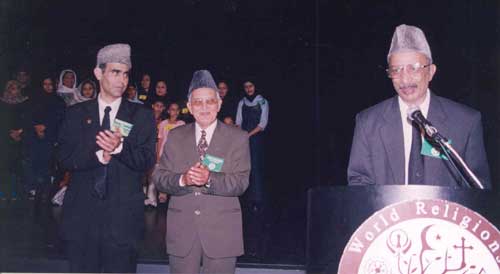
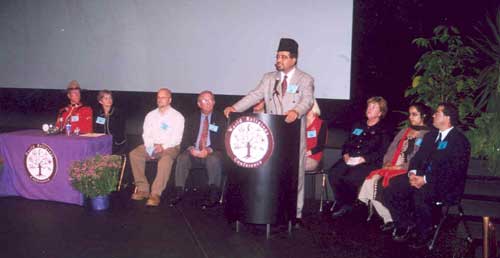
The National President of Ahmadiyya Movement in Islam, Mr. Naseem Mahdi, thereafter delivered his short introductory speech. He mentioned that the motive behind holding such conferences is to create interfaith harmony and religious reconciliation and understanding so that we can live in a peaceful environment. He regretted that in the present political situation, Canada, notwithstanding its image of a champion of world peace, has opted to join the US in attacking Iraq.

In the opening ceremony of the conference, each speaker was given five minutes to introduce
themselves and the religion or philosophical system they represent. In the theme session after Lunch break, each representative delved upon the plan of action his/her religion provides for the promotion of peace and harmony. The order of the speakers had already been decided through a ballot.

Just before Lunch, a group of multifaith children participated in a lively multifaith presentation of songs and melodies from their respective faiths.

During the theme session, the first speaker, Dr. Christopher diCarlo, presented the atheistic or what some people prefer to call, humanist, solution of the problem. He suggested that we should ignore metaphysical concepts and should concentrate on here and now; seek the commonalities amongst different people and the common origin of humanity to illustrate the idea of fraternity and common ancestors. In his opinion, human nature avoids pain and suffering and seeks comfort; whereas religions demand humans to inflict pain on themselves.

The second speaker, Mr. Tom Schmucker in his introduction stated that the Hebrew word "shalom" means peace and Jesus was the manifestation of shalom. He absorbed violence but did not inflict violence. Later, in his detailed exposition, Mr. Tim Schumucker narrated stories of some devoted Colombian Mennonite Christians who are doing social welfare and aid works amidst the fierce internal warfare. In the end of his presentation, he lamented upon the Crusades waged by fanatic Christians in the name of religion. He deplored the loss of life, property and above all, the sacred religious values at the hands of religious warriors.

Amar Erry brought in a Hindu point of view (not the Hindu perspective) on "World Peace - What religions can achieve." Introducing Hinduism he said that his religion is nothing but "Shanti" and "bestower of happiness". There being no "ism" in Hinduism, peace and happiness can be attained through returning to "Parmatma" (The Supreme Being) through practicing in compassion, good works, personal effort and prayers. Erry asserted that mere absence of armed conflict does not mean the presence of peace. The struggle to achieve the elusive goal of establishing peace starts from within and grows outside the human mind (spiritual to social peace continuum). Forces of good and evil are in continuous collision course with each other. It is imperative that the forces of goodness be strengthened and supported through proper understanding of each other though mutual respect.

The Hindu presenter brought seven sins of mankind in the Ghandian philosophy: wealth without work, pleasure without conscience, knowledge without character, commerce without morality, science without humanity, worship without sacrifice and politics without principles.

Speaker from a Buddhist perspective, Norman Feldman, presented the teachings of the Buddha as a starting point to end the habitual forces of greed, hatred and ignorance in human life. These are the causes of "Dhukha" or the presence of suffering and conflict. But through meditation and investigation of life human condition can be improved through the Middle Path, which encompasses areas of thought, intentions, speech, actions, livelihood, and effort. A well-trained mind brings permanent peace and real happiness in the world.

Feldman further elaborated that the most profound insight lies in coming to understand the nature of things, i.e., impermanence, unsatisfactoriness and interdependence of things. The experiential realization of these characteristics leads to less greed and hatred and less-centred way of living. This recognition of inter-dependence of every thing in life and wise and compassionate actions lead to the end of suffering, stress and conflict. He stressed that mere presence of religion does not guarantee peace. Rather, individuals and groups of individuals taking the teachings to heart and putting them into practice is the way to go. Feldman cited various examples of non-harming, non-discrimination, environmental concerns, reconciliation, meditation that promote and bring about peace and security in various parts of the world

"What is hateful to you, don't do to your neighbour. This is the whole Torah; all the rest is commentary". This is Judaism in a nutshell, according to Alexandra Kuperman, a Jewish representative at the U of Wterloo symposium on world peace.

The important challenge is how does one turn yearning for peace into action. There are three ways in which peace the Torah addresses promotion. The first is by removing causes of war (hunger, poverty, despair etc.), the second is by describing the messianic time period (a time characterised by peace) and the third is by stripping holiness and honour from those who engage in wars.

Kuperman concluded that Torah and Talmud seem to tell Jews that war is a legitimate approach to certain situations but peace is ideal. There is a whole set of laws called Darkei Shalom, the path of peace, that cause other laws to be altered to bring about more peaceful and equitable relations. Texts and teachings of individual traditions need to be revisited and explored, but most of all put into action, she said.

Santbir Singh of Vancouver explained an understanding of Sikhism in relation to world peace. At the outset he laid out two very fundamental principles of human life, i.e., recognition of the Divine within and selfless service to others.

In this strictly monotheistic religion there is no division between a religious aspect and a non-religious aspect of life. Sikhism rejects asceticism and monasticism and seeks to become a part of every day life and change it from the inside out.

Singh asserted that at the heart of Sikhism is the need for social justice and the dignity of all human beings. This serves two purposes: it is a vehicle for social change and activism and a tool for spiritual fulfillment and personal development. It is a holistic approach to the human condition in aspects of personal, political, social, economic and spiritual conditions. The egalitarian and global outlook of Sikhism is the corner stone of peace in all aspects of human existence.

Native representative, Norma Geauvreau, highlighted Native belief system which has belief in One Creator as central idea. This Creator, according to her has breathed His spirit in all living beings including animals and plants. All the things on this earth help man to survive and live. She mentioned that Native people don't have chiefs. The idea of leadership is based upon giving to others. The clan who gives more is considered leader of the nation. This idea is called Pot lach. Upon the basis of this idea of giving, Native people welcomed all the settlers on their land and shared the resources with them. She told the audience that eagle is very important manifestation of life flying high with its two wings representing man and woman. If they cooperate with each other, eagle continues to fly high.

The Last speaker, Mr. Mubarak Ahmad Nazir, missionary of Islam presented the Islamic perspective of peace. He mentioned the coincidence of Islam being last religion and him being the last speaker as representative of Islamic faith. Mubarak Nazir very eloquently described the idea of Jehad in Islam. He told the audience that striving against one's own evil ambitions, giving good training to children and raising them properly and spreading truth is greater Jehad; whereas fighting to defend oneself is lesser Jehad. He quoted certain verses of the holy Quran stating that Allah does not like unruly and transgressors who run across the land to spread disorder and unrest. He censured carpet bombing, ethnic cleansing and suicide attacks and stressed the importance of working in harmony and to do justice to all nations to achieve peace.

Each religious or philosophical perspective was a followed by a lively Religious and cultural spiritual presentation by sung by a group of representatives of the respective faith. These presentations most beautifully reinforced the theoretical concepts discussed.

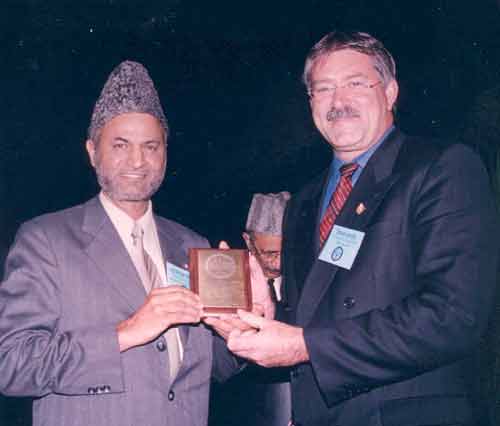
Dr. Sajid Quraishi, Local President of the Ahmadiyya Movement in Islam presented his vote of thanks to all the organizations, presenters and over 100 volunteers who worked tirelessly to make the event a success. Lal Khan Malik, National Vice President of the Ahmadiyya Movement in Islam, Canada, presented a plaque to all the speakers and to the moderator, Mr. Dave Levac (MPP) as a token of appretiation.

Thereafter, the all speakers were invited to an interactive session with the audience and they responded to numerous and diverse questions put from the audience.

Numerous spiritual and religious groups set up interesting and attractive displays which attracted many guests of the conference.

The conference ended with a great atmosphere of brotherhood and every one was feeling a commitment inside their hearts to work in harmony with each other for the establishment of world peace through religious ideas.

HIDDEN WHITE TEXT HERE

© 2008 Ahmadiyya Muslim Jama`at Inc. | WRC HOME | WRC Archives | Organizers | Partners | Sponsor | History | Contact us |