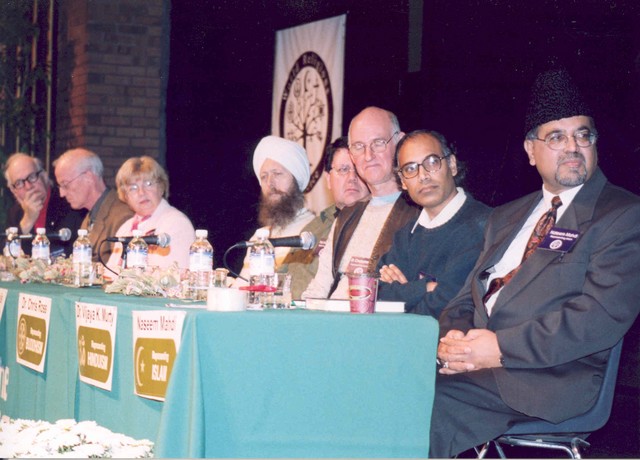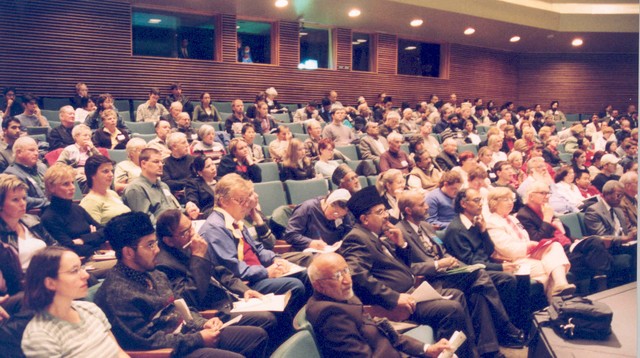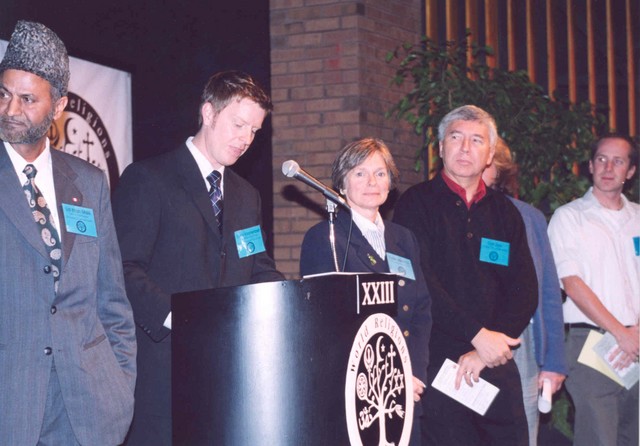

XXIII World Religions Conference - Speakers at Head Table
Theme: In Search of the Existence of God

- Over 700 delegates from numerous faith traditions attended
- Special
Message from Hadrat Khalifatul Masih V, Mirza Masroor Ahmad
- Greetings
from National and Provincial Leaders of Canada
- Welcome
from University Officials, including the President of the Federation
- Renowned
Speakers from eight faiths and philosophies deliberated
- Faith
groups sang spiritual poems and songs
Report by Nabeel Rana,
Information and Public Relations Officer
World
Religions Conference
WATERLOO, October 4, 2003.
As seekers in search of
truth, the first issue that must be resolved is the question of God’s
existence. The search for the existence of a supreme being transcends all
cultures, races, ages, genders and backgrounds. No matter what our station
in life, we eventually form some conclusion to this question that confronts
our unified existence. This is the beginning point for all religions and
philosophies because our outlook on everything else is built upon the
foundation laid by this answer.
It was drizzly cool Saturday
morning, when a long line up of cars waited to enter the parking lot at the
University of Waterloo Hagey Hall. The sprinkle like rain only added to the
jubilation of the event as it popped conference décor balloons blown around
the conference venue building. Inside the Hagey Hall, the cozy and exquisite
Humanities Theatre was filing people from various faiths and philosophical
traditions. Despite the weather, some 700 guests had gathered to listen ‘the
search of the Existence of God’. It was the Ahmadiyya Movement is Islam,
Brantford Branch’s, 22 year old tradition. The
celebrated World Religions
Conference, was being held with all its famous traditions and with the
cooperation of the Ahmadiyya Muslim Students’ Association of the University
of Waterloo and several other organizations. During recent years the event
has gained much popularity with insightful and strategic efforts of the
organizers.
The 6 hour long conference
was "excellent and dramatically organized" a professor of the university
commented.
The event was presided and
moderated by Mr. Darryl Konynenbelt, a famous Anchor and Reporter of
CKCO-CTV television of southern Ontario.
Like every year, renowned
scholars of various major religions were invited. This also included a
philosopher from the Atheist community as specified in the guidelines of the
World Religions Conference written by the Promised Messiah and al-Imam al-Mahdi.
The selection of speakers is tedious and year-long process. Partner
organizations representing various faiths and philosophical traditions after
initial screening; nominate the best and most-competent speakers for the
final review and final approval of the organizing committee. Careful thought
is given to the background, qualifications and popularity of selected
speakers.
The conference began with
the most beautiful recitations and readings of various Holy Scriptures of
different
faiths along with their respective English translations. The
conference was formally opened by the unveiling of the "World Religions
Conference Plaque"— a plaque which lists the topics and dates of previously
held conferences. Delegates from diverse religious, cultural, social and
academic backgrounds were in attendance.
Greetings for the delegates
were received from dozens of National and Provincial Leaders, including the
Prime Minister of Canada and the Premier of Ontario. Present amongst the
dignitaries at the event were Janko Peric, Member of Parliament (Cambridge),
Ms. Karen Redman Member of Parliament (Kitchener Centre) and Mayor Carl
Zehrs (City of Kitchener, Ontario).
Mr. Chris Edey, President of
the Federation of Students of the University of Waterloo and Ms. Catharine
Scott, Associate Provost Human Resources and Student Services from the
University of Waterloo were also present to greet and welcome guests on
behalf of the
University of Waterloo.
The National Vice President
of Ahmadiyya Movement in Islam, Canada, Mr. Lal Khan Malik, thereafter
delivered his short introductory speech, and introduced the Worldwide
Ahmadiyya Movement in Islam.
A special message was also
received by the Supreme Head of the Ahmadiyya Muslim Community, Khalifatul
Masih V, Hadrat Mirza Masroor Ahmad from London, U.K. Mr. Lal Khan Malik
read the message of His holiness to the delegates of the event. In his
message, Khalifatul Masih V expressed his pleasure to see ‘God’
in the
centre of the search at the conference. Quoting from the sayings of the
Promised Messiah and al-Imam al-Mahdi, he said that a large part of the
world declares that it believes in God, yet at the same time it is engulfed
by the impurities of the world and steeped in the evils of sin. How then is
it that there is so much opposition to God and such courage is shown in
disobedience to His laws? Hadrat Khalifatul Masih V hoped that this
Conference would enable all who participate in it to acquire a true belief
in a Truly Perfect God, a God Who is Most Gracious and repeatedly Merciful.
In the opening ceremony of
the conference, each speaker spoke for five minutes on the question of ‘why
he or she believed in his/her faith?’. In the theme session after Lunch
break, each representative spoke on the theme “In Search of the Existence of
God”. The order of the speakers had already been decided months earlier
through a random draw.
Multi-media on-screen
projection to a 30 feet screen in the theatre supplemented to the
gorgeousness and attraction of the various presentations of different
speakers.
Keynote Address:
Mr. J. W. Windland, Director
and Founder of the Encounter World Religions Centre of Guelph elegantly
presented the Keynote address at the event. The address, entitled In
Search Of The Existence Of God: Primary Perspectives Of World Religions
surveyed fundamental perspectives of three common categories of world
religions.
Perspectives reviewed
include the nature of God or the Ultimate, the association of humanity to
God and the world, the religious goal, and the interpretation of scripture.
Appreciation of another’s faith can be enhanced through awareness of the
other’s defining religious perspectives, he said. Albeit oversimplified,
this Keynote provided valuable insights as it highlights some underlying
ideologies of world religions in a way that is easily understood and easily compared.
Islamic Perspective:
Mr. Naseem Mahdi, National
President and Missionary Incharge of the Ahmadiyya Movement in Islam,
Canada, and renowned scholar and speaker on Islam, presented the Islamic
perspective “In Search of the Existence of God”. He presented seven
messages, or seven arguments based on the teachings of the Holy Qur’an, the
Islamic Scripture.
Mr. Mahdi, established on
the basis of several verses of the Holy Qur’an that Muslims believe in all
the Prophets of God, may they be sent to any people, era or land of the
world. He argued that when all of them said that there is one God, and God
spoke to them, it is not possible to reject the testimony of so many
prophets of the last 6000 years, from Adam to Abraham to Moses and so on.
In another argument in
support of the existence of God, he said that if we observe our own body, or
this world, or the universe and we see it so beautifully done. It is
impossible that it has just come into being by a consequence of mere chance
or spontaneous creation.
Mr. Mahdi, further
elaborated that in the 1940s and 1950s, for scientists, the word ‘God’ was a
taboo, and most of them were atheists, but in the last 20 ~ 30 years, the
scientists, when their knowledge has increased, they are coming very
strongly to this conclusion that there must be someone, whether we call him
‘Allah’ or ‘God’ or ‘Primatama’ or whatever, but there is some ‘superpower’
who is controlling this universe.
He said that all prophets,
were persecuted and prosecuted. Invariably, he said, all of them have become
successful in the final analysis. How is it possible that this is all just
by chance and it was only a coincidence that all the prophets (without
exceptions) were in the final analysis victorious? he asked. It was really
the force of God, Almighty working for the final victories of His chosen
prophets, he said.
Then he presented the
argument of acceptance of prayer, he said. Whether one is a Christian or a
Jew or a Sikh or a Hindu or a Muslim or belongs any other religion, they all
can give the testimony of the acceptance of prayers.
Presenting another argument
of the existence of God he said that God speaks to his chosen ones and
prophets and tells them what will happen in the future. He said that when we
see those prophesies being fulfilled, we have no doubt on the truth of those
prophesies, or on the existence of God.
Last, but not least he said
that God says that if you come to Him and if and you strive and if you want
to know Him, pray to Him and He will guide you. Even if an atheist,
addresses God and says to God: “O God if you ever existed, I want to come to
you!”, I am sure He will guide the atheist, he concluded.
Hindu Perspective:
According to the Hindu
Speaker, Dr. Vijaya Kumar Murty a learned Hindu Scholar and professor of
Mathematics from Toronto, one’s faith refers to one’s understanding of
certain principles and one’s experience, and this understanding and
experience are not static, but dynamic. He said that the Ultimate Reality
does not change, but our understanding of It, our experience of It, and our
approach to It does change according to the state of our own spiritual
evolution. Thus the same question will be answered differently depending on
when it is asked, he said. With this proviso, Dr. Murty said that there are
indicators that suggest that there is something that transcends and is
immanent in the perceptible world. We are struggling to discover that
spiritual reality.
In our spiritual journey,
there are innumerable means that we may employ. There are also three tests
that can be used to test whether we are moving towards the truth: the
testimony of the wise (including the words of scripture), reasoning and
experience. When these three tally, there is reason to have greater
conviction that one is looking at the truth, Dr. Murty explained.
Buddhist Perspective:
Dr.
Christopher Ross, a recognized academic scholar of the Department of
Religion and Culture of Wilfrid Laurier University and a practicing Buddhist
of the Riverview Dharma Centre of Waterloo presented the Buddhist
perspective on the subject. He questioned that what does Buddhism offer
Western searchers and refugees from turbo-capitalism and -some of - its
cultural religious reactions? Buddhism offers something less dramatic and
less reassuring than the existence of god. Buddhism offers a pondering upon,
a meditation upon, the reality of impermanence, the self-serving delusion of
the self, that is a defence against that reality of impermanence, and which
binds us to what Sigmund Freud called the return of the repressed, what
Buddhists term the karmic wheel of conditioned cause/effect responding, he
explained. Our self-graping ignorance finally blinds us to the nirvanic
insight that this is all there is, in all its naked splendid poverty.
Consciousness is what we have. It is what we share. It is empty. What will
we fill it with? He questioned.
Aboriginal Spiritual Perspective:
Professor Malcolm Saulis, a
well-famed Traditional Aboriginal Spiritual teacher presented the Aboriginal
Spiritual Perspective in Search of the existence of God. He said that his is
rooted in the Ancestral Understanding which is evident in all elements of
his life. He said that to comprehend the Spirituality of Indigenous people
is with reference to the worldview that evolves from the Ancestral
teachings. This worldview if Wholistic in nature and this reference point
contains all of the knowledge for the human to interrelate with Creation and
all of the elements of Creation. The Wholistic understanding is expressed in
the ceremonies, songs, dances, medicines, drums, prayers, daily lives, etc.
of human life, he explained. According the Professor Saulis, Humans are
related to all other elements of the world and they are no better or worse
than even the most minute element of Creation. The teachings are of great
teachers and require the human to be constant in their efforts to learn what
lesson is contained in “every leaf and rock”, the professor concluded.
Sikh Perspective:
Singh Sahib Guru Fatha
Singh, and ordained Sikh minister, author and teacher of the Kundalini Yoga
explained the Sikh perspective on the existence of God. He said that many
honorable people before us have lived in pursuit of God. Countless have
spent their years in pursuit of happiness. I pursue neither. Guru Fatha
Singh explained that we can no more find God in this universe than we might
find Canada at the University of Waterloo. There are doubtless many
excellent books and courses on Canada at this respected school. There will
be graphs and pictures, films and historic relics, maps and statistics here,
but we are unlikely to find more than an iota of the vast and elegant entity
we have come to know and love as “Canada” in such things.
Books and courses and graphs
and pictures and films and relics and maps and statistics and schools and
professors and students exist in Canada. Canada also exists in them in an
abstract kind of way. But they are not Canada, he explained.
In this same way, God has
its own enfolding characteristics and so long as we live, we will never find
God. We can never find God, for God is never lost. And God has never been
lost.
Guru Fatha Singh said that
the priests of every religion – including Sikh religion and atheism – may
tell you God is to be found, or alternately that God does not exist because
it serves their interests to say so. We are six billion people beguiled by
the jealous interests of religious monopolies, by the natural limitations of
thought, language and imagination, and by our unconscious routine of
self-denial. Ultimately, we are not what we think. Neither is “God”, He
explained.
There are many fictions.
There are many legends. There are many analogies that can be made. In the
midst of our generalized confusion, the loving god of our imaginations has
been made a point of contention, the rationale for bloody wars of “religious
conquest” and ruthless movements for “religious purity”, he said.
Guru Fatha Singh explained
that according to the first Sikh Master, Guru Nanak, Supreme Being exists
purely in the peace-giving form of a disciplined saint. Otherwise - in
ingenious dogmas and arguments, in self-righteous posturing and dressing up
religious, in “holy wars” and persecutions - for all practical purposes, God
does not exist, he explained.
Jewish Perspective:
Dr. Judy Wubnig, a
well-known scholar on Judaism and a former professor of the University of
Waterloo presented the Judaic perspective. She questioned if God or do gods
exist? If so, what is the nature of the divine?
She explained that
Rabbinical Jews believe that God gave Moses laws about how the children of
Israel should live, so the position of these agnostic thinkers like the
Buddha is not possible. The view that God is a lawgiver is not unique to
Jews. Greeks also thought this; for example, in Rabbinical Judaism, whether
God exists or what his attributes are not issues, she explained with the
help of a passage from Genesis.
She explained in the Bible
He appears as the Creator of the Universe, Lawgiver to the Hebrews - the
tribes of Israel, just, merciful, sometimes angry, loving, sometimes he is a
father, sometimes a shepherd to his people.
She explained that Aristotle
gave another proof in his work the Physics (VIII); Aristotle argued that
everything that moves (changes) must be moved either by something else or by
itself. There must be an Unmoved Mover of the motions of the universe, who
moves but is not moved by anything. This Unmoved Mover moves eternally, is
one, and has no parts and so no sized life, the best possible.
Elsewhere Aristotle argues
that this Prime Mover leads a blessed life, the best possible. The most
divine activity is thinking, so the Prime Mover thinks continually about the
best things - thinking itself, she said.
According to Ms. Wubnig, the
questions about the existence of God and of His attributes have been
important for that branch of Judaism that developed into Christianity
because of the influence of Greek philosophy. But, so far as I know, she
said, the only Jewish philosopher who investigated these questions as part
of Judaism was Moses Maimonides, much influence by Aristotle; his views
about these matters, however, have had little influence on mainstream
Judaism. Jews like herself who study philosophy, of course, study proofs
for the existence of God as part of philosophy, but not as a study of
Judaism, she concluded.
Christian Perspective:
Dr. John North, Professor of
the Department of English and member of the University Senate and the Board
of Governors presented the Christian perspective at the conference. Dr.
North is the founding chairman of the Pascal Lectures on Christianity.
Dr. North confined remarks
to describe only those issues on which all three branches of the historic
Christian church are in agreement: the Orthodox Church, the Roman Catholic
Church and the Protestant churches.
He said, that his search for
God depends on the Christian Bible, both Old and New Testaments; the
testimony of eminent men and women past and present; the great literature
which is the focus of my professional career; fellowship with other
Christians of all ages and cultures and races; the world of nature; and most
especially through my daily private and public prayer. For me, he said, as
for all Christians, the focus of our faith is Jesus Christ, God incarnate,
creator and sustainer of the universe and of everything therein, whether or
not those created ones acknowledge him. Christians believe that each human
being may have profound communion with Christ, who is co-equal with God, he
explained. He believed that communion is premised on our forgiveness and
redemption, the result of our faith in Jesus’ birth, crucifixion,
resurrection and ascension.
Dr. North said that if we
were to ask him for the most succinct introduction to Christian doctrine, he
would direct us to the Nicene Creed. For the life of Jesus Christ he would
suggest reading the Gospels, especially the Gospel of John and Jesus’ Sermon
on the Mount in the Gospel according to Matthew, chap 5-7. This is simple
reading that has strength for the mind of a child as well as the mind of a
scholar, in his opinion.
Quoting a professor of his,
he said: “The worst conflicts between the religious are less often between
the devout than between the dilettantes.” And quoting from another
professor of his: “If God in Jesus Christ is the Way, the Truth, the Life,
as he claims, then any area in which we refuse to search for God is a
potential trap for our future.” Then, he repeated the statement of a
Russian Christian visiting Conrad Grebel College at the height of the Cold
War: “the chief enemy of the Christians is not any organization or any
person, but rather sin itself within the Christian heart and mind.”
Explained, he said that a chief purpose of his throughout his life has been
to obey Christ when he says, “Thou shalt love the Lord thy God with all your
mind, all your heart, all your soul, and your neighbour as yourself.” In
conclusion he said that the joy of such love far outweighs the suffering.
Atheist Perspective:
Dr. Jan Narveson, a member
of the Department of Philosophy at the University of Waterloo, a famous
Atheist Philosopher presented the Atheist view in search of the existence of
God.
He said that atheism is merely the absence of a religion. It is a belief,
and it is a belief about religion - namely, that religion is a
mistake, at least intellectually speaking. He explained that science is
coming along pretty well and will continue to do so, and whatever we know
about the universe around us, it will become known by scientific work. He
said that atheists do not think that the claim that there is a "god" or
"gods" contributes anything to our understanding of the world - quite the
reverse: it contributes misunderstanding and confusion. He said, however, he
thinks that it does not matter very much in itself. Far more important is
the effect religions have had, and continue to have, on the moral views of
religious people. These effects are of different kinds, but there is one
kind of effect that has been, in his opinion, very bad indeed and which it
is very important for every religion to guard against: and that is, the
tendency to suppose that religion is the foundation of morals, Dr.
Narveson explained. It is not, and it can, he believed, be strictly
proven that it is not and cannot be. Nevertheless, too often religions have
behaved as though all other people who do not share that particular religion
are, as it were, beyond the pale of morality and do not count. Or even, that
they count negatively and may, come to that, be eliminated, by force. This
kind of group egoism, as it amounts to, is the cause of a huge amount of
evil in today's world, as it has been in the past, he explained. And that is
why, Dr Narveson expressed that meetings like this seem to me to be
important. Somehow, the proponents of different religions need to appreciate
that the other people in the world count - that everybody, regardless
of their religious beliefs or lack of beliefs, is owed the basic duty of
respect and nonviolence, he said.
Prof. Narveson sees no explanatory value in any religious hypothesis.
According to him, there is certainly no evidence, actual or even possible,
for the hypothesis that the world was "created" by some kind of super
intelligent mind, and in a way there is a sort of evidence against it. The
evidence against it is that it sure doesn't look the way one might expect it
to look if it was created by a good super intelligent mind, Prof
Narveson thinks. However, he expounded that, the real point is simply that
the hypothesis of god doesn't explain anything. If you claim that the world
was "created" by such a being, you owe us an explanation how the "god" in
question is supposed to have done it. He said that, but of course you will
be unable to explain this; indeed, what you will probably say is that it is
"beyond human understand". So he said that why bother with the hypothesis at
all? A hypothesis which is unintelligible is no better, surely, than no
hypothesis at all, but it could easily be a lot worse, since it might impede
efforts to come up with real and plausible explanations that really do tell
us something.
Summing up his contribution to the conference, he said: if our 'search for
god' comes to a dead end, we shouldn't worry about it, because we're
probably better off this way. He said that people should much rather take
comfort in their friends, families, and in general in the truly remarkable
qualities of the many, many people around them who have done so much to make
this world a terrific placed to be, than that they buries their heads, as it
were, in a fog and took what seems to me an illusory comfort in myth
instead.
-----------
Each religious or
philosophical perspective was a followed by lively Religious and cultural
spiritual poems and songs, sung by a group of representatives of the
respective faith. These presentations most beautifully reinforced the
theoretical concepts discussed.
Dr. Sajid Quraishi, Local
President of the Ahmadiyya Movement in Islam presented his vote of thanks to
all the organizations, presenters and over 100 volunteers who worked
tirelessly to make the event a success.
Thereafter, all the speakers
were invited to an interactive session with the audience and they responded
to numerous and diverse questions put from the audience.
Numerous spiritual and
religious groups set up interesting and attractive displays which attracted
many guests of the conference.
The organizers of the event
also set up a informative and attractive display, elucidating and
highlighting the history of the World Religions Conferences held in Canada
during the last 22 years. This included numerous clippings from various
newspapers that have been covering the event for many years.
The
conference ended with a great atmosphere of brotherhood and every one was
feeling a commitment inside their hearts to work in harmony with each other
for the establishment of world peace through religious ideas.
[To read this proceedings
report in Urdu - go here]